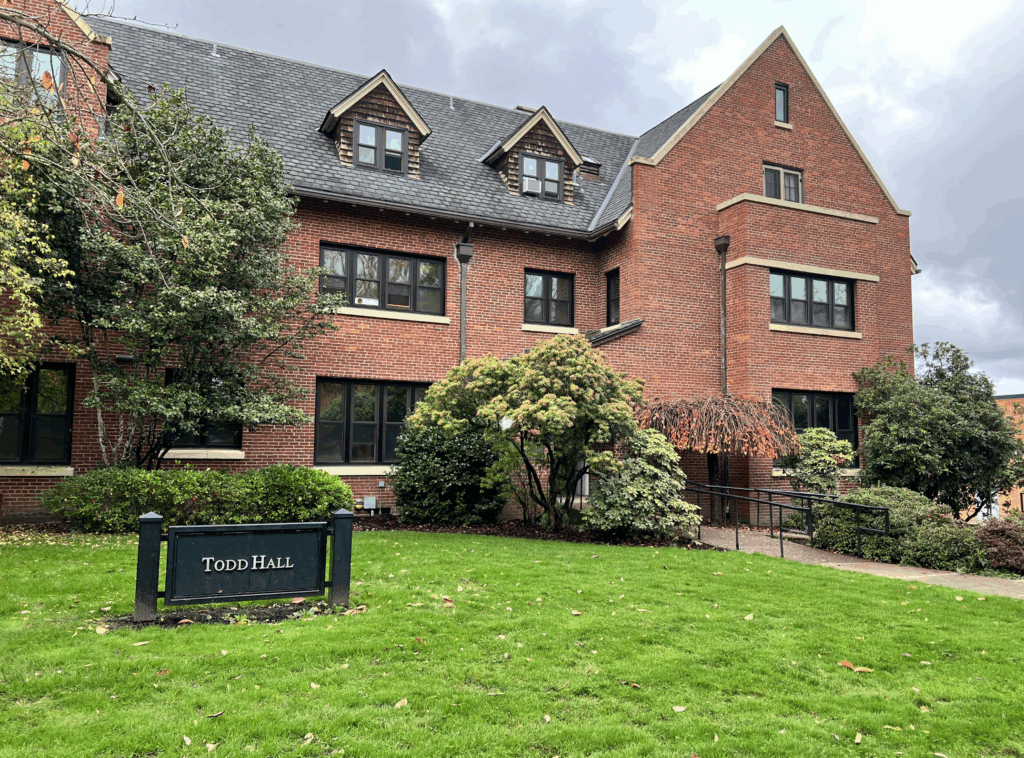
Todd Hall was built in 1912 and was originally 10,800 square feet, costing about $50,000 — equivalent to $1.65 million today — to build. With its steep roof, small glass windows, red brick detailing and chimney, the building was constructed in a Tudor style, common for the time period. The original purpose of Todd Hall was to house students on campus, with students starting to move in in 1913. In 1921, additional dorm rooms were added to the building along with a second dining room, and later in the same year renovations took place to add the West Wing, the Music Room and the Arcade. The kitchen and dining room were moved to the new Student Center in 1960 and the space was transformed to only encompass dorm rooms, a living room and two study rooms. This remodel cost about $31,000. The building started housing the Teaching Research Division in the 1970s, until it eventually became the Todd Hall we know with classrooms, offices and PsychPAC. Todd Hall received its namesake from Jessica Todd, the first dean of women and the first director of dormitories at Western. She was born in 1869 in Beaver Falls, Pennsylvania, and moved to Monmouth in 1912 when she became the supervisor of critic teachers for Monmouth Training School. When Todd moved to Monmouth and started working at Western, she recognized a need for a dormitory on campus and helped petition to the state for funds to build a women’s dorm, ultimately leading to the construction of Todd Hall. In 1926, she received an honorary baccalaureate in recognition for her exceptional work on campus. When she eventually retired in 1931, the Oregon State Board of Education unanimously agreed to name the dormitory she directed after her, thus creating Todd Hall. Jessica Todd was a strong advocate for women living on campus, but was known for her very strict nature. Her dormitory was strictly an all-girls dorm, and she was often reported to push her teachings of how to be a “proper woman” onto the girls living in her dormitory. She would promptly lock the dormitory doors right at curfew and make her residents say goodbye to their dates right before she did so. For these reasons, the girls in her residence would often be known to sneak boys in through the basement — which was then the laundry room. Jessica Todd eventually died in 1944, but it is speculated that her spirit may live on. Rumors have spread around campus that her ghost still lives in Todd Hall to this day, and students often report strange occurrences like hearing footsteps or seeing lights flicker. Most of her ghost sightings originate from the bathroom because it was the room that used to be her living space. It’s also theorized that her ghost targets men specifically because her building was an all-girls dormitory and she doesn’t like men inside. Whether these speculations are true or not, Jessica Todd was one of the big reasons women were able to have a place to live on campus, and paved the way for the historic and unique Todd Hall known today.
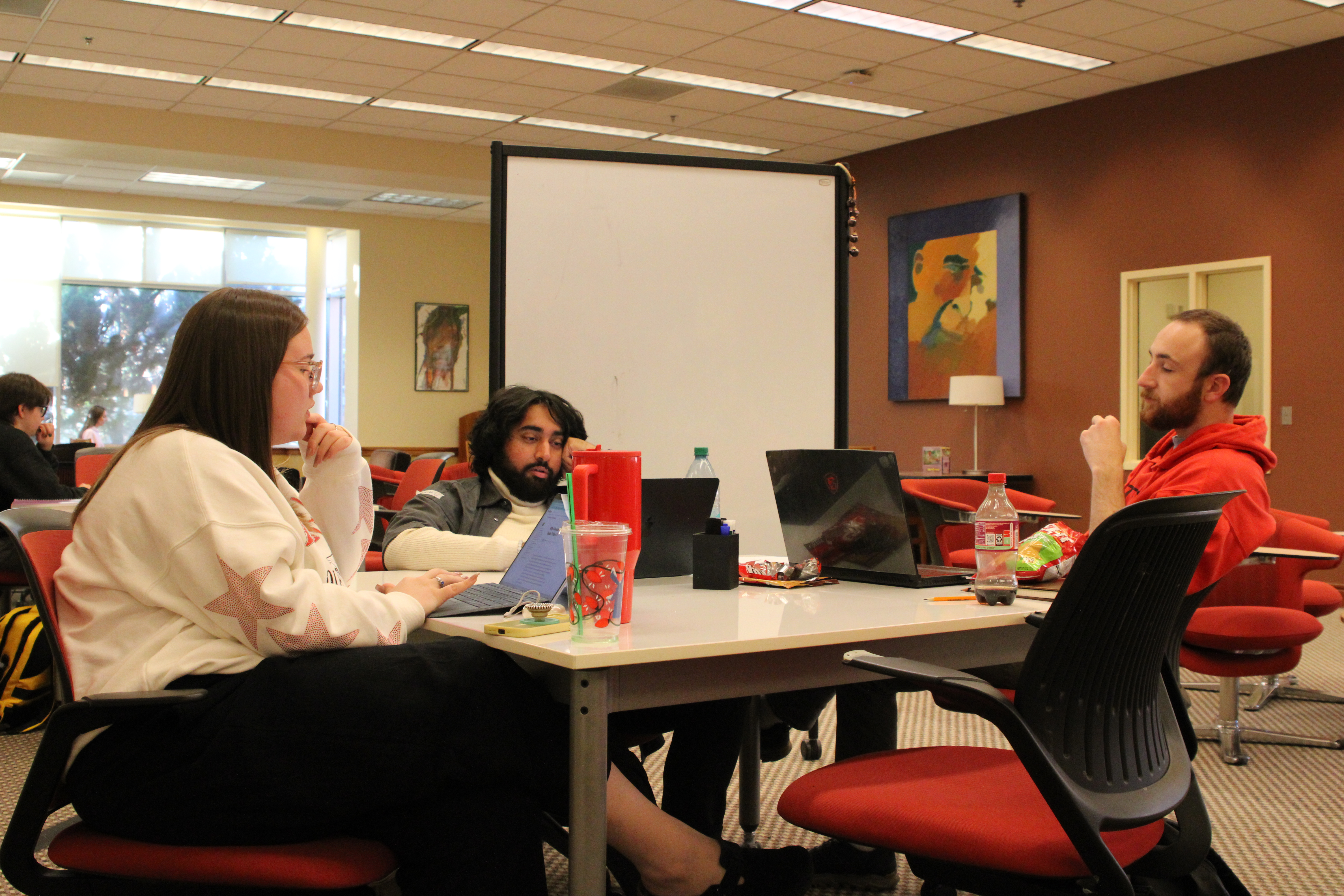
A photo of a student study group in the Hamersly library. Pictured left to right: Kalyn Gambill (junior), Preet Dhaliwal (senior) and Richard Loos (junior). | Photo by Hannah Field
Nov. 19 2025 | Hannah Field | Editor-in-Chief
Starting Jan. 5, 2026, all staff members will be required to work on campus five days a week due to a request by Western president, Jesse Peters. The request excludes faculty, meaning professors, but includes all other full-time employees at Western, such as janitorial staff, advisers, counselors, administrators and others.
Any part-time staff member may review their hours with their supervisor, who will then, on a case-by-case basis, determine the best course of action for the staff member. No further information was disclosed regarding the new rule and the effects of the changes are yet to be seen until Winter term begins.
According to Western spokesperson Maureen Brakke, faculty are encouraged to be on campus and communicate with the community as much as possible. With that in mind, the university is aware of additional responsibilities connected to teaching, scholarship and service, leading to greater flexibility for faculty hours. Many professors on campus are long-distance, either via commute or purely teaching online. While the potential of that changing seems unlikely, Western in the new year will be pushing toward in-person classes more than ever before.
“This decision comes in light of WOU’s strong tradition of in-person classroom instruction, with many faculty and students expressing a preference for enhanced face-to-face learning experiences,” said Brakke.
With in-person classes as one of the main priorities of Western at this time, President Peters also requested that the Academic Affairs Division assess undergraduate courses and determine which should be offered as hybrid or fully online options. Considering previous statements from Western, it’s likely that fewer online courses will be available.
Those changes, however, have no announced timeline. The faculty will complete an audit of online and hybrid classes by the end of Winter term, which will then offer more information to the school about maintaining or altering those as online options.
With that information being gathered at the end of March, it’s unlikely that any major changes will take place in the Spring term of 2026 following the week-long break.
“Nothing will be changing immediately,” said Brakke.
A photo of the king tides crashing over a large rock. | Photo from @tillamookcoast on Instagram
Nov. 19 2025 | Abbi Duhart | News Editor
King tides — formally known as perigean spring tides — made an appearance along the Oregon coast Nov. 4-7. These tides occur when a full or new moon reaches perigee, when the moon is at the closest point in orbit to the Earth, and when the sun, moon and Earth are in alignment. The combination of these two things creates a strong gravitational pull on the ocean, which leads to higher-than-normal tides that push waves the furthest upshore. In general, king tides are the highest level of tides that can be predicted. Scientists have pointed out factors that contribute to these recent king tide occurrences being more drastic and deadly than others. Over the past decade, sea levels have continued to rise drastically from climate change. The continually higher sea levels cause king tides to reach a higher point on the shore. Additionally, the coast has faced turbulent weather, with large wind and rain storms causing harsher conditions in the ocean. The high levels of wind cause water to swell, intensifying the waves and making the king tides stronger. Normally, king tides aren’t as dangerous, but the combination of all these factors made the tides that occurred recently the most dangerous that have happened. Newport, Oregon was hit the worst, and was reported to have tides that rose higher than 10 feet. Oregon scientists discussed the high possibility of erosion and flooding. Because the tides were predicted to be so harsh, it was likely that the tides coming so far into the shore would create erosion along the sand and rocks. The tides combined with the stormy weather were a big indicator for flooding as well, potentially even up to U.S. Route 101. Scientists are using the king tide occurrences to observe and document the impacts rising sea levels have on erosion and flooding. The king tides often attract tourists, whether it be for photography or just viewing. While watching them can be an amazing opportunity, residents are advised by Oregon scientists to remember the dangers they create. Those who go are encouraged to watch from a safe distance and area, and remember to never turn their back on the ocean. Many residents enjoy visiting the beaches after the tides occur as well, because the high tides often bring in copious amounts of sea treasures for collectors. If anyone likes sea combing, they are recommended to visit right after the king tides because they often yield the best finds. For those who missed these occurrences of the king tides and would like the opportunity to go see them, the tides will appear again Dec. 4-6, 2025, and Jan. 1-4, 2026.
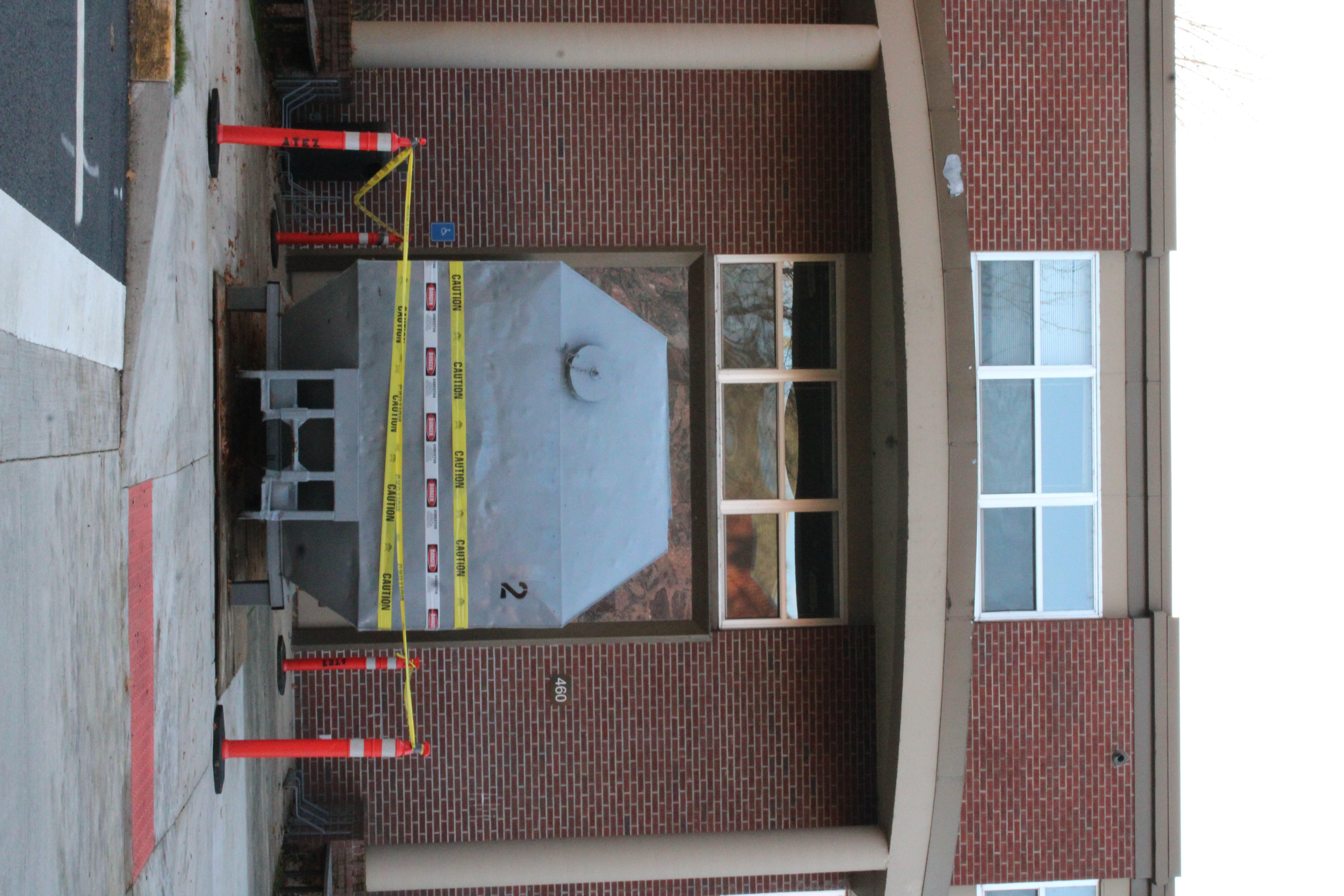
Maaske Hall while under construction for asbestos abatement. | Photo by Hannah Field
Nov. 19 2025 | Hannah Field | Editor-in-Chief
Maaske Hall is facing renovations through the end of Fall term on the first floor. Construction began Monday, Nov. 17, and is expected to take roughly three weeks. In an email sent out to campus, the school reported that a contractor would perform asbestos abatement, which is the process of identifying asbestos and removing, repairing or encapsulating it. Asbestos is a cancer-causing substance, affects the lungs through irritation and causes scarring to the lung tissue. Most often found in buildings or cars, asbestos is present in many buildings built before the 1980s, found in various places such as piping, insulation and roofing. It was a common building material before it was found to be harmful, because of its anti-corrosion and heat-resistant properties. Due to the risks, the first floor was sealed off to the rest of the building as well as the outside. Students, staff and faculty are asked to not attempt entry into the first floor of Maaske Hall. An exterior elevator is present for use on the north side of the building to enter upstairs, with many offices in the building for faculty on the second and third floors. Further renovations are reportedly coming in the following Winter and Spring terms, including new flooring, lighting and fresh paint, but no further information was released hinting at what kind of changes or upgrades are coming to the building other than the overall goal: to build a Forensic Education Center. The center will be an interdisciplinary collaboration in the College of Liberal Arts and Sciences, led by the Division of Criminal Justice and the Department of Chemistry. “The space will provide hands-on learning in the field of forensics and provide opportunities for wider community and regional engagement,” said Rebecca Chiles, assistant vice president, in an informative email sent to campus. Maaske Hall is tucked between the Werner University Center and the Math and Nursing Building. It harbors no classes, so students often pass right by it, and many were previously unaware of any inside damage or potential harm, up until the asbestos abatement began and a large danger-sealed gray hallway was sealed to the front doors. Ideally, it’ll attract students for more than their professors’ office hours with the planned Forensic Education Center, which is a first for Western and could spark a lot of positive change in the college community.
Contact the author at howleditorinchief@mail.wou.edu
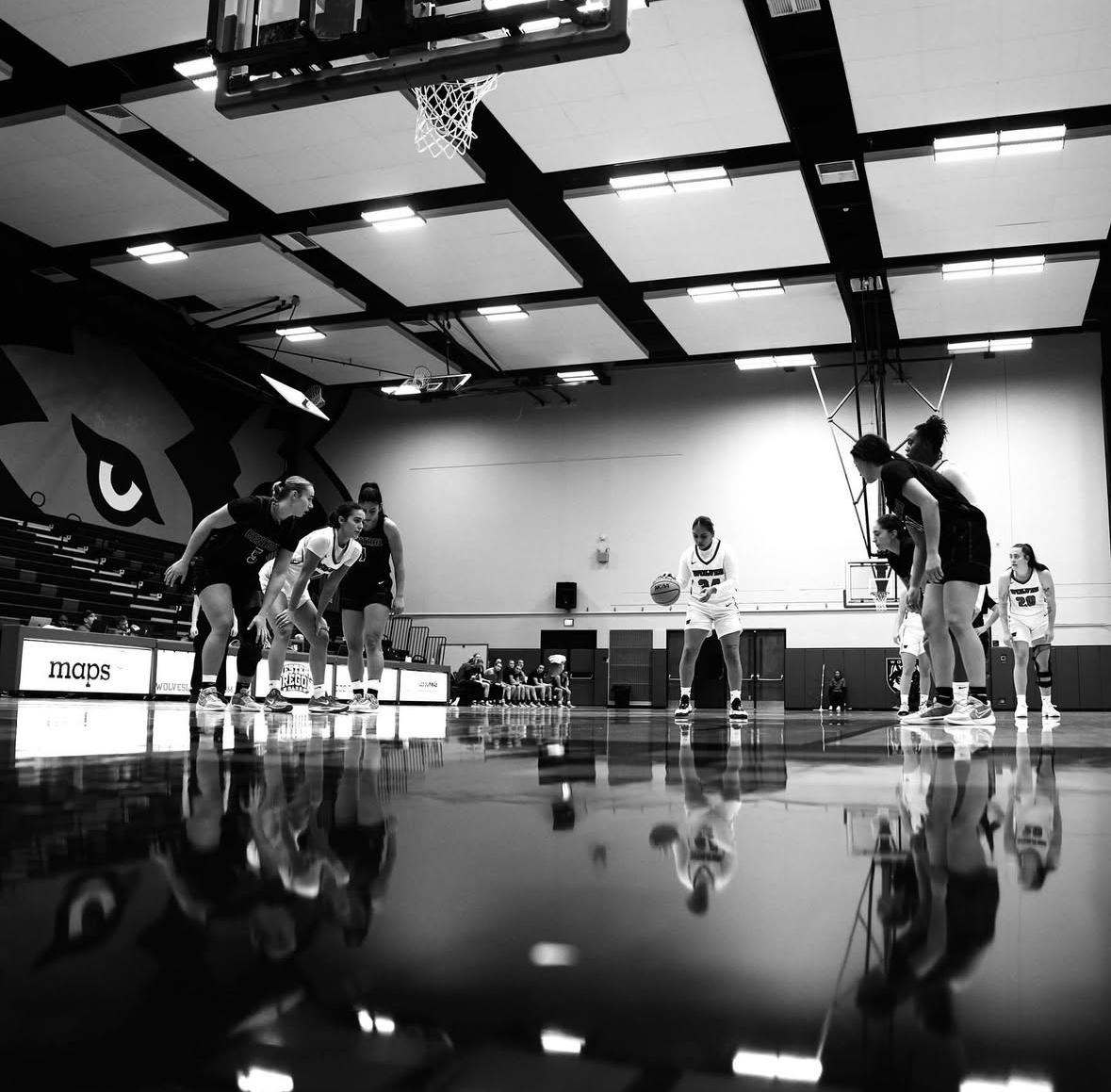
A black-and-white photo of the 2023-2024 women’s basketball team playing a match at Western, posted Dec. 4, 2023. | Photo from @wou_wolves and @wouwbb on Instagram
Nov. 19 2025 | Hannah Field | Editor-in-Chief
In January of 2025, nine former basketball players from the women’s team at Western filed a $28.2 million lawsuit against the college, coaches Jessica Peatross and Demetrius “DJ” Marlow, athletic director Randi Lydum, Dean of Students Malissa Larson and President Jesse Peters, alleging abuse from coaches Peatross and Marlow that, once reported, led to retaliation via rescinded scholarships.
The 2023-24 women’s basketball season was cut short with six games left without detailed explanation from the university following a practice Feb. 12, 2024. Western conducted an internal investigation while Peatross and Marlow were put on paid administrative leave Feb. 19 until being reinstated two months later after no conduct violations were found.
Recent investigations from the Statesman Journal reported the internal investigation, handled by law firm Littler Mendelson P.C., had “misquoted players, misconstrued situations and misstated what happened during a contentious practice on Feb. 12, 2024, and in the days after it.”
The alleged event included one player, Hanne Hopkins, who bumped into Head Coach Peatross during a drill, which turned into Peatross accusing Hopkins of running into her intentionally and telling her to leave practice, and was captured on video saying “I’m your coach. Get out. Get out. Y’all don’t get a choice.”
The day after, Peatross called the Monmouth Police Department and said she was intentionally elbowed in the chest at the practice and she had left practice to go to the hospital, where she experienced pain on a scale of 1-10 at a 10, and that it felt even worse the next day.
The video taken on a team member’s phone shows Peatross “talking calmly” after the alleged incident, said the Statesman Journal.
Two days after that, Peatross filed a report with Campus Public Safety and said she was experiencing chest and head pain, shortness of breath and nausea. The police officer whom Peatross spoke to earlier tried to contact Peatross for a month following the incident, but heard nothing back, and was denied access to the video by the university according to the Statesman Journal. From there, the investigation was requested to be closed due to “lack of cooperation,” per the police officer.
Monmouth police officers were eventually able to review the video and saw no indication of forceful or intentional contact from the player to Peatross. Police also did not see evidence to support Peatross being injured or in pain.
The team soon met in a small conference room where, when asked, 10 players voted to not play the six games remaining in their season. According to the Statesman Journal, some of the players expressed feeling pressured by the coaches to leave the team, with Peatross allegedly giving an ultimatum to player Ana McClave: “You either quit or you come and you kiss my ass.”
Both coaches were placed on paid administrative leave Feb. 19, 2024.
Players also alleged intense physical activity during practices, noting physical illness, dehydration and vomiting. The lawsuit states that if they did not complete the exercises, the punishment was more laps, with McClave stating, “The running we had to do, it wasn’t for speed, quickness or strength, it was for harm and to see how they could break us.”
One player, Kailiana Ramos, reported losing 20 pounds, and McClave was forced to engage in practices without being cleared by a doctor after knee surgery. Player Jodi Noyes said that Peatross and Marlow claimed “nobody’s welcome back” on the team after they learned of private discussions about the coaches.
Additionally, the lawsuit alleges NCAA rule violations, such as forcing players to miss their classes, pray before games and sign sheets that indicate they “weren’t practicing too much,” with team bonding events on the calendar actually being excessive physical exercise practices.
Peatross allegedly suggested that Noyes quit taking her antidepressant medication in November of 2023. Noyes obliged, but told university staff, who said it would be reported to athletic director Randi Lydum. No changes followed, and it’s unclear if Lydum did or did not receive the information. Lydum and Dean of Students Malissa Larson met with four players individually and “promised immediate changes that never happened,” wrote the Statesman Journal.
The lawsuit states that Lydum told a player, “These coaches deceived us, and this is not what we wanted for the school.”
The coaches were reinstated in April of 2024. A small group of players met with WOU Board of Trustees Chair Betty Komp to explain the situation, but no action took place. Letters came in April 23 to players still eligible to play that said their scholarships were terminated.
Littler Mendelson, which is based in the U.S. and is the world’s largest firm specializing in labor and employment law, was paid $33,696 to conduct the investigation by Western. The firm claimed that Feb. 12, during the practice where Peatross alleged she was elbowed intentionally, that Hopkins, the player who made contact with Peatross, was warned to not perform the action by McClave. The investigation also claimed that the lawsuit inaccurately reported Hopkins’ response to Peatross following the event, which was captured on camera, despite citing the video filmed by a player. It also allegedly wrongfully stated which players were told to leave and who was allowed to stay at practice, and contained conflicting information regarding who remained.
The investigation implied that the three students — Hopkins, McClave and Ramos — involved in the conflict failed to follow university conduct when they did not immediately oblige Peatross’ demand for them to leave. The report also did not clarify the intention in the contact between Peatross and the student.
In another incident, McClave claimed that Assistant Coach Marlow collided with her Jan. 4, 2024, reinjuring her left knee post-surgery. The Littler Mendelson report “casts doubt if McClave was injured in that collision,” according to the Statesman Journal. However, McClave documented being in pain and sought help from athletic trainer Sara Gordon.
The report itself implicated team members Ana McClave and sister Cali McClave of having a negative influence over the culture of the team and implied criticism of team members for addressing concerns with Lydum over Peatross and Marlow. The players were addressed as “problematic” in the investigation and it also stated that Lydum appeared to understand that.
Western denied the request to share the report with the Statesman Journal. Following an appeal that handed the report to the Statesman Journal, Western filed a lawsuit against journalist Bill Poehler, who was providing coverage on the ongoing lawsuit, requesting a court order to clarify what information the university is required to submit. Ultimately, Western was ordered to provide the documentation by a district attorney.
Western is seeking to dismiss the lawsuit from the nine basketball players. The lawsuit was moved to federal court in February of 2025; the Statesman Journal reported, “The sides are in a lengthy discovery process that has a deadline of June 5, 2026.”
A photo of the Wolf Pups with visitors from the Veterans Resource Center. | Photo courtesy of Tammy Gardner
Nov. 12 2025 | Abbi Duhart | News Editor
Wolf Pups — formally known as the Child Development Center — is a school and daycare area on campus where parents in the community and enrolled parents at Western can drop off their kids aged 2 1/2 to 5. The center has been up and running for 45 years, and was originally in Todd Hall, but moved to its new residence in the Child Development Center behind Campus Public Safety. They are part of the Student Affairs division at Western. Currently, there are three classrooms and 46 kids enrolled. A helpful resource they also provide is a dual-language classroom for children who speak English and Spanish. Additionally, they provide a young preschool room that supports children who still need to work on potty training, as well as kids with disabilities. The original purpose of the Child Development Center was to serve Western students who are also parents by providing a space to assist parents in being able to attend things such as their classes. Currently, they serve Western students, faculty and members of the community, but the most prominent customers now are members of the community. The center is funded by the IFC for student parents with children enrolled, meaning that Western students with children enrolled receive a sizable discount. A large Preschool Promise grant is also offered to around 30 parents who are low-income, covering the full payment to enroll their child. The staff at the center encompasses around 25 individuals, including three full-time teachers, two full-time assistant teachers, one half-time assistant teacher and 15-20 student staff who attend Western and are most often enrolled in the Education program. Tammy Gardner, the director at the Child Development Center, explained that they wouldn’t be able to run the center without the large number of student teachers they get. Gardner emphasized and wanted to highlight that the center is so thankful for and “couldn’t believe the love and support and resources that were given to the preschool, it’s absolutely amazing, and not just to the students, to the families and the staff here.” The Wolf Pups partner with many different departments and faculty around campus, and have expressed feeling so welcomed by them as they bring joy to the kids. Recently, trick-or-treating for the Wolf Pups in the Werner University Center involved over 30 clubs and organizations around campus, setting up tables and going all-out with decorations, costumes and prizes or candy for the kids. The preschoolers came and had so much fun going to all the different tables; Gardner mentioned, “I will tell you, it was so amazing that after the kids left, I just sat in the WUC and cried.” During Halloween, Campus Public Safety also takes out one of the patrol cars to fire up the lights and sirens and take the kids on little tours. She also mentioned the great partnership they have with the Natural Science department. Beeb Singson from the department has set up various experiments and lab tours for the kids to come in and do, like an exploding volcano and an earthquake demonstration that are both educational and fun. They’ve worked with Michael Gonzalez from Athletics, who has invited them to play basketball with Western’s basketball teams. Members of the football team have also come in to visit the kids and play with them. Gardner explained that doing this is so enjoyable for the children and a way for them to meet amazing athletes. Rip Horsey, the director at the Health and Wellness Center, has also set up times for the children to come into the gym and have fun with all of the different activities offered. Tim and Corrie Cowart, professors in the Dance department, have come in to teach the children mini dance classes as well. The kids love this, and it’s a great way for them to have fun interactions while being active. Currently, the center is also working with the graduate occupational therapy program because they wanted a place for their grad students to engage and observe little children as a way to prepare for their future careers. Each graduate student comes in to teach a lesson plan to the kids, and the kids enjoy it because “they’re young and fun,” as phrased by Gardner. Gardner also had Logan Doerfler from the Veterans Resource Center come in with a crew to have a special story time about Veteran’s Day with the preschool classes. Doerfler and his crew dressed in uniform and discussed how they serve people and keep them safe, as well as deliver food and water. Campus Dining provides the Child Development Center with all of the food they need, such as lunches and snacks. The center has expressed gratitude over the hot meals and two snacks a day they receive and how Dining is willing to accommodate, even sending treats like cookies occasionally. All in all, the Wolf Pups at the Child Development Center are thankful and appreciative of all the resources and activities provided by departments and faculty around campus. The center is a great resource for students attending Western who have preschool-aged children. While the faculty at the center are pleased with how welcoming everyone on campus is, the children have the opportunity to be enrolled in such an amazing space where they can participate in many offered activities from organizations on campus. The people who take time out of their day to volunteer for these events know it’s all worth it to see the joy on even one child’s face.
A photo of an ICE agent touching a protester in a gas mask outside of Portland | Photo from @killendave on Instagram
Nov. 5 2025 | Abbi Duhart | News Editor
ICE is slowly becoming a known presence in the Willamette Valley. With a multitude of restraints and arrests happening in areas like Salem and Woodburn, residents are starting to fear for their lives and their family and friends. Often driving unmarked vehicles, residents are even concerned with being able to identify when ICE is coming. Students at Western have received instructions on what to do if ICE comes to campus from Western administrators, Unidos Migrant Student Association and Western’s Young Democratic Socialists of America organization, as well as various resources for knowing their rights.
On Oct. 30, more than 30 people were restrained and arrested in Woodburn by ICE. The Portland Immigrant Rights Coalition, a hotline that residents of Oregon can contact if someone they know has been detained, received numerous calls that carloads of people were stopped and arrested while on their way to work. Loved ones were calling in to report that their families hadn’t arrived home from work. The number of calls like this that they receive has only been increasing since.
Juan Larios, the Woodburn School District superintendent, alerted parents to the presence of ICE agents and reassured them that the district does not partake in any sort of immigration enforcement and will not allow ICE agents to access any school building.
Similarly, the superintendent of Salem-Keizer School District, Andrea Castañeda, has informed families that ICE agents are not allowed to enter school buildings or access student records without a court order. Many families in the Salem-Keizer area have expressed fear, as many come from immigrant families. Confirmed by the Salem police department Oct. 30, immigration authorities are operating in and around Salem. The Salem police explained, though, that they receive no notice when ICE agents come into Salem.
With the looming threat of ICE agents, it’s important for students at Western to know their rights. If a student is approached by an ICE agent on campus, they should call Campus Public Safety immediately at 503-838-8481, and can additionally call the Office of the General Council at 503-838-9471. All ICE agents are required by law to check in with Campus Public Safety before they take any action, so students can call Campus Safety if approached and can respond to agents by saying, “I do not consent to anything.”
The presence of ICE, and even thinking about ICE, can be extremely distressing for students. For these reasons, students are also encouraged to utilize mental health resources around campus. The Student Health and Counseling Center is available to students Monday through Friday, 9 a.m. to 12 p.m. and then 1 to 5 p.m. Students can make a crisis appointment by calling 503-838-8313. Additionally, students can contact the Unidos Migrant Student Association, which is actively advocating for students and hosts informative events to help students understand what to do in these situations. They also have many useful resources, such as documents with example scenarios and responses for students.
If anyone becomes aware of the presence of ICE agents in protected areas, such as on campus at Western, they can call the Sanctuary Promise Hotline at 1-844-924-STAY. Students can also sign a petition provided by the Western Oregon University Young Democratic Socialists of America that calls the university to declare the campus a sanctuary to students of all backgrounds, implement an alert system, train staff and faculty on how to interact with ICE, provide training and information to students and pursue options for financing legal support centers. Students who wish to sign this petition can find the link on their Instagram: @wou_ydsa.
A photo of a kid wading through heavy floodwater in the Dominican Republic. | Photo from @washingtonpost on Instagram
Nov. 5 2025 | Abbi Duhart | News Editor
Hurricane Melissa is one of the most powerful hurricanes that has occurred in the Atlantic Ocean to this day, having ripped through the Northern Caribbean and leaving thousands of people without power and homes. When the hurricane reached Jamaica Oct. 28, it was reported as a Category 5 hurricane with wind speeds up to 185 mph. A Category 5 hurricane is the highest level classification for hurricanes and means the storm has winds at 157 mph or higher and is accompanied by catastrophic damage.
On Oct. 30, the hurricane reached Jamaica and caused major destruction, affecting residents and even taking lives. Many residents were left without a house after the storm, and many lost personal belongings due to waterlogging. The storm also wiped out roads and bridges, making it harder for Jamaican residents to get assistance after the storm hit. Eventually, helicopters flew in to distribute food, water, medicine and other necessary supplies. During the aftermath, search and rescue teams found at least 19 dead, and more than 13,000 people remain in crowded shelters because they lost their homes. Seventy-two percent of the entire island was left without power.
Similar damage occurred in Cuba, but the Cuban Civil Defense was able to evacuate 735,000 people before the storm hit.
Haiti was also badly impacted by Hurricane Melissa, with at least 30 deaths occurring and 20 residents reported missing. Port-au-Prince, the capital, faced some of the worst damage. Hurricane Melissa brought heavy rain storms, flooding a vast majority of the area and rendering homes inaccessible. Residents slowly started to return home Oct. 30. The hurricane destroyed homes and ripped apart families, as children were reported killed. More than 15,000 people were staying in shelters during the aftermath. In Haiti and Cuba, the tremendous amount of rain and flooding left communities with hundreds of residents completely isolated with no way to contact anyone for help.
Hurricane Melissa caused at least 50 deaths throughout Jamaica, Haiti and Cuba, but this number is expected to rise as experts continue to search the islands for those reported missing. After these devastating events, Hurricane Melissa moved away from Bermuda the morning of Oct. 31 as it died down to a Category 1 hurricane. By 11 a.m., the storm grew smaller and was classified as a powerful post-tropical cyclone with winds around 85 mph, traveling to the northeast. As the storm continued in this direction, the northeast U.S. coast and parts of Canada were expected to be impacted by the storm, primarily through large rain storms. While it will most likely not bring the same damage to land as it did in the areas above, the storm will still create harsh conditions in the ocean near the shore.
A photo of the route for roadwork in Monmouth and Independence. | Photo courtesy of Oregon Department of Transportation
Oct 29 2025 | Abbi Duhart | News Editor
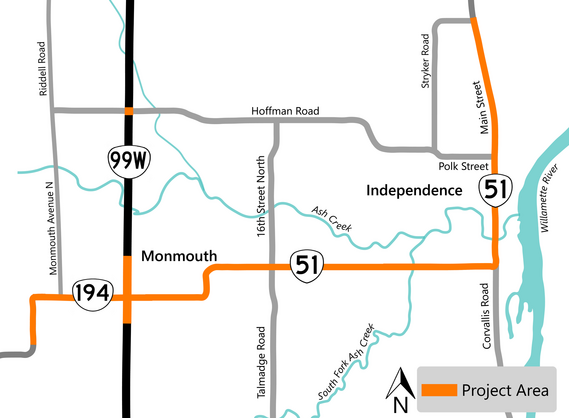
Construction and road work has begun throughout main roads in Monmouth and Independence. Here’s what students and residents in the area should expect from the construction phase and the outcome.
While construction lasts, crews will be working along Main Street, Monmouth Street and South Main Street. Residents should expect to see construction crews at work Monday through Thursday during normal business hours, with occasional work on Fridays and at night when needed. As of Oct. 29, only shoulder closures have occurred, which doesn’t change the flow of traffic, but residents should be prepared for possible lane closures and shifts as needed. In that case, drivers will see flaggers directing traffic. Additionally, residents should expect some loud noise at times, as construction workers are using loud machinery. The Oregon Department of Transportation asks that residents be aware during this time, and that they slow down and watch for workers.
The reasoning behind the construction is to add curb ramps along Monmouth and Independence sidewalks to meet current ADA accessibility standards. Workers are adding and remodeling 150 ramps in the area. These new curb ramps will make it easier for people to transition from the road to the curb, and vice versa, while walking around town. Accommodations such as these will help those who have trouble stepping up and down from the sidewalk, as well as wheelchair users. The changes can additionally help people with strollers, walkers, hand carts and bikes.
Residents may notice that not all ramps are being built on the same timeline. This is because workers must review each corner where a ramp will be placed and evaluate it to see if it is ready or needs modification before a ramp can be built. Additionally, not all intersections and locations are the same. Some areas are construction-ready, while some areas have things to plan around, like fire hydrants, utility boxes and utility poles. The construction-ready intersections are being worked on first, while others will be completed at a later date as ramps are designed around the intersections’ barriers.
These construction ramps are part of a larger project throughout Astoria, Corvallis, Cottage Grove, Newberg, Salem, Keizer and Springfield, in addition to Monmouth and Independence. Design and construction for these changes totals $1.56 million. Residents can check an interactive map provided by the Oregon Department of Transportation here to see which areas are currently under construction.
The work being done locally is part of a larger project throughout the Willamette Valley and North Coast to bring over 2,300 curb ramps to ADA standards. The Oregon Department of Transportation is working hard to bring accessibility to cities and towns like Monmouth and Independence that will benefit everyone.
A photo of Vice President JD Vance taking questions regarding the government shutdown at a press briefing. | Photo from @whitehouse and @vp on Instagram
Oct 29 2025 | Hannah Field | Editor-in-Chief
On Oct. 1, the United States government ceased its operations and entered a shutdown, following Congress’ failure to pass the bills necessary to fund those operations. Republicans and Democrats failed to agree on how the money would be used throughout the government, resulting in the shutdown, limiting governmental operations across the country and endangering certain benefits for millions of Americans.
For the most part, students remain unaffected by the shutdown. Western students can continue to attend class and participate in their typical activities, but there may be some instances where students are impacted.
It is expected that thousands of Oregonians will lose their food stamp benefits, known as SNAP, after Oct. 31 due to the stalled funding. While most receiving benefits are not college students, the students who do receive food stamps will lose their access alongside an estimated 41 million Americans.
Western students who have compromised food aid due to the shutdown are encouraged to connect with resources on campus, such as Abby’s House and the Food Pantry, to avoid further food insecurity. Food banks are expected to be heavily utilized following Nov. 1, meaning resources may be limited across the country.
Another way students may be impacted is through travel. Demand for air traffic controllers has been high since well before the government shutdown, but now many are not coming to work, despite being considered essential workers — all of whom are expected to work without pay during government shutdowns. Due to the lack of staffing, many flights are experiencing cancellations or delays, namely at major U.S. airports such as Newark, Phoenix, Nashville, Dallas, Denver, Las Vegas and Burbank, and likely more as the shutdown progresses. Security lines through checkpoints at airports may be longer than normal as well.
Thankfully for students, funding for FAFSA, student loans and Pell Grants has not been suspended. Federal grants awarded to schools will continue, but new grants may face delays. Students across the country may be let go from work-study jobs depending on funding.
While many things are still up in the air regarding the government’s funding, one thing is certain: the longer the shutdown, the more it will affect. Millions of Americans on SNAP will continue without benefits, essential workers will keep working for free and travelers will face further roadblocks.